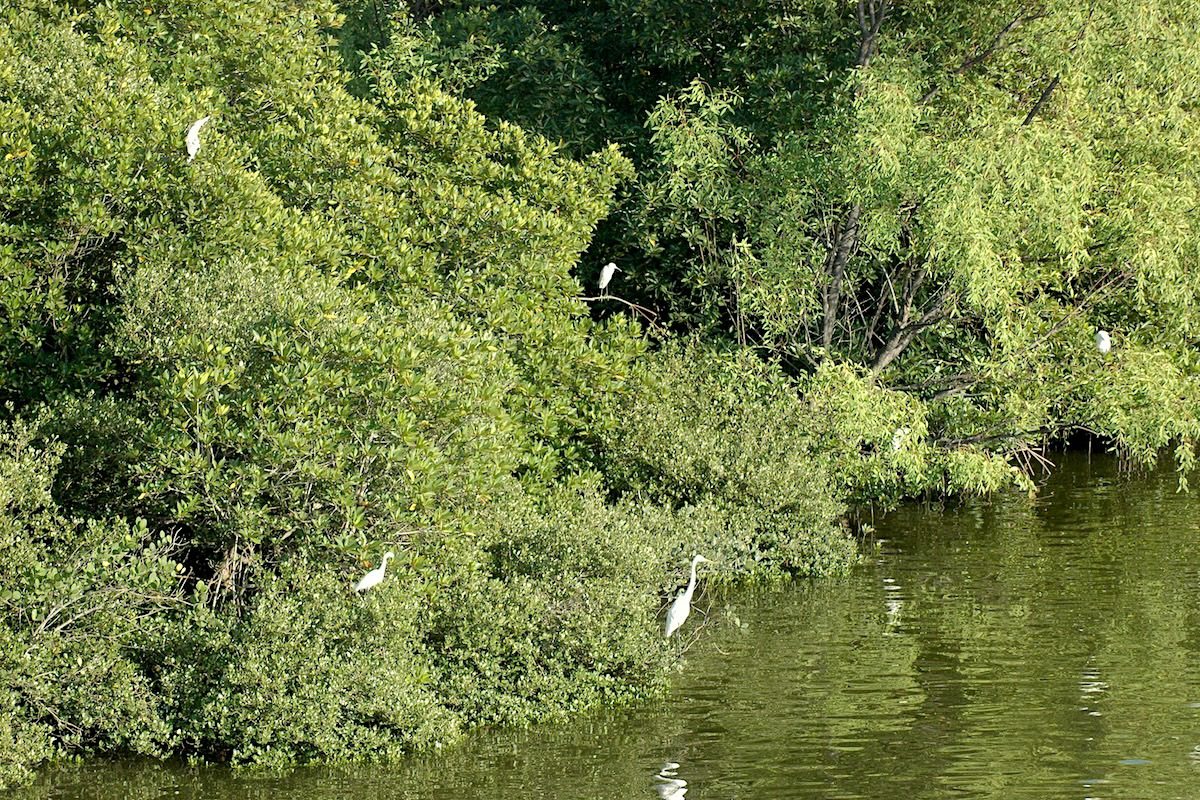
A push by China to revive its mangrove forests is paying off. Not only have mangroves colonized large areas of coastline, but the new forests have drawn scores of new bird species.
Over the last half of the 20th century, China lost roughly half of its mangrove forests. By 1998, mangroves spanned some 26,000 acres of coast, satellite imagery showed. But by 2020, that figure had risen again, to roughly 70,000 acres.
While China has pushed to plant large areas of mangroves, the expansion has also been spurred on by warming, which has allowed trees to push northward, researchers said. Meanwhile new laws aimed at protecting mangroves ensured the survival of fledgling forests.
The trees, which grow in intertidal waters, are a boon to wildlife. Their dense, tangled roots slow incoming waves, keeping coastal waters clear of sediment, and also absorb pollution. Plankton thrive in clear coastal waters, attracting fish and other sea creatures, which in turn attract birds. Between 1998 and 2020, the number of bird species recorded in mangrove forests rose from 148 to 397, according to the research, published in The Innovation.
The study did not distinguish between planted forests and natural forests, though other research has found that natural mangrove stands host a greater diversity of wildlife.
The mangrove comeback is not limited to China. The 20th century saw half of all mangroves destroyed globally, many of them eradicated to make room for fish and shrimp farms. But recent analyses have found that mangroves are now expanding faster than they are declining. The abandonment of aquaculture has been a major factor. Much of the growth has also been driven by warming, as in China, which has allowed mangroves to colonize new areas.
What Is Driving the Global Resurgence of Mangrove Forests?
Arctic Wildlife Research Suffers as Geopolitical Competition Grows
Fifty Billion Seedlings: Can Ethiopia Replant Its Ravaged Forests?
By Samuel Abate and Freddie Clayton