SpaceX just launched a classified mission for the U.S. military.
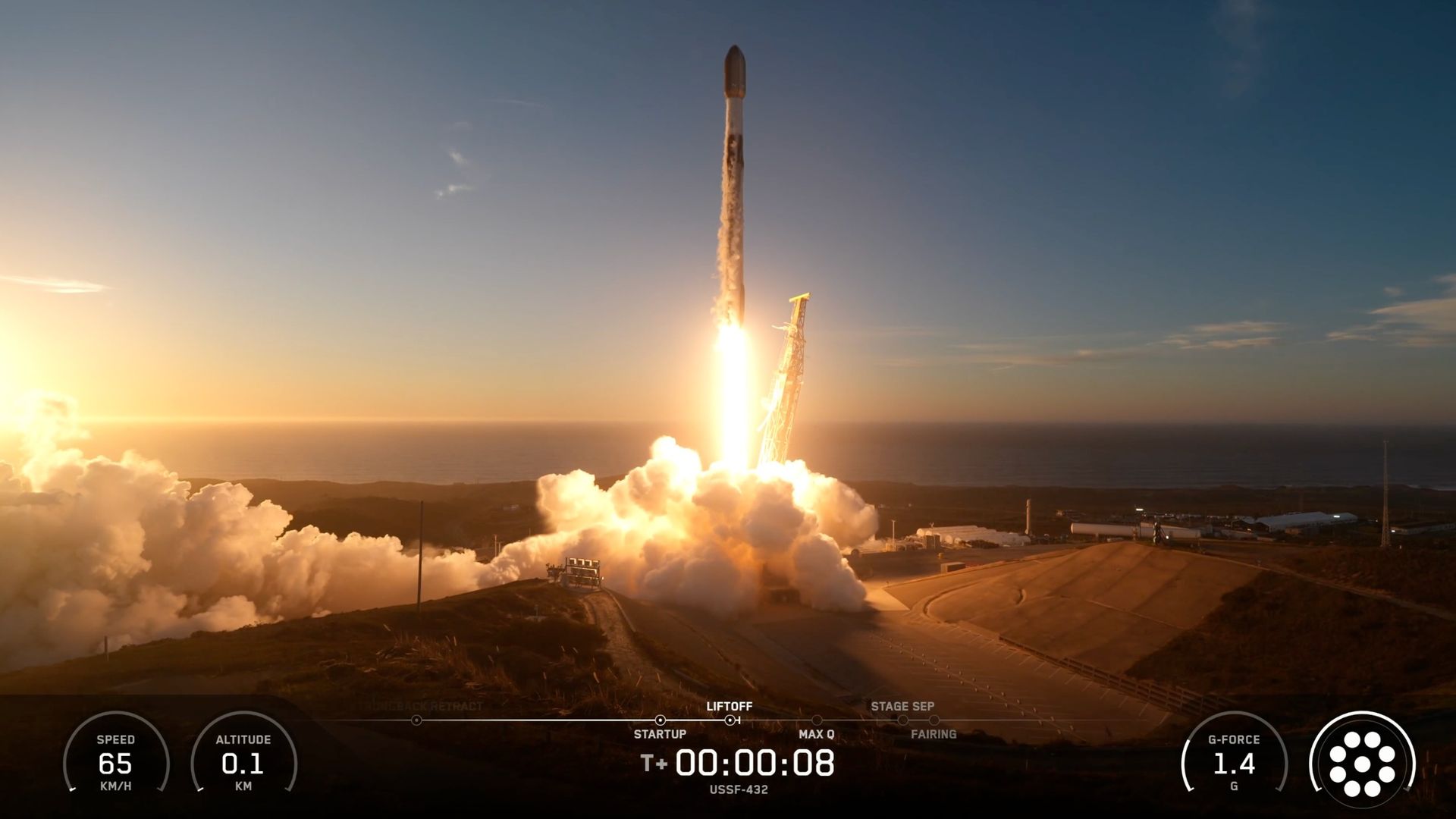
A Falcon 9 rocket lifted off from California's Vandenberg Space Force Base this evening (Nov. 6) at 7:48 p.m. EST (4:48 p.m. local California time; 0048 GMT on Nov. 7), rising into the sky as the sun sank toward the Pacific.
The launch kicked off the USSF-432 mission for the U.S. Space Force , which we know little about. Neither SpaceX nor the Space Force told us much about USSF-432 beforehand, and we learned tonight; SpaceX cut its webcast off about 10 minutes into the flight, shortly after the Falcon 9's first stage came back to Earth for a landing.
That touchdown occurred aboard the SpaceX droneship "Of Course I Still Love You," which was stationed downrange in the Pacific Ocean. It wrapped up the eighth flight for this particular booster, which is designated 1095.
The Falcon 9's upper stage, meanwhile, continued carrying its mystery payload skyward. It could be headed to low Earth orbit , outside observers speculate.
"It is possibly a batch of classified LEO satellites for the USSF's Space Based Sensing and Targeting (SBST) portfolio based on SpaceX's Starshield satellite bus, based on locations of rocket stage drop zones being exact fits with previous Starlink Group 15 launches," NextSpaceflight.com wrote in a mission description .
Starlink is SpaceX's LEO broadband megaconstellation, which consists of more than 11,000 active satellites. Starshield is a similar system designed to provide services to the U.S. military and its allies. Starshield satellites are believed to be based heavily on the Starlink spacecraft bus.
GPS-III 8 | 6 Starlink missions
USSF-432 was the 119th Falcon 9 launch of 2026, and the 14th national-security flight of the rocket so far this year. The vast majority of Falcon 9 missions in 2026 — more than 70% — have been devoted to building out the Starlink megaconstellation.
SpaceX has also launched six other missions this year. Three were operational flights of the company's Falcon Heavy rocket, while the other three were test missions of its next-gen Starship vehicle. SpaceX plans to retire both the Falcon 9 and Falcon Heavy shortly after the fully reusable Starship, the biggest and most powerful rocket ever built, is up and running.
Michael Wall is the Spaceflight and Tech Editor for Space.com and joined the team in 2010. He primarily covers human and robotic spaceflight, military space, and exoplanets, but has been known to dabble in the space art beat. His book about the search for alien life, "Out There," was published on Nov. 13, 2018. Before becoming a science writer, Michael worked as a herpetologist and wildlife biologist. He has a Ph.D. in evolutionary biology from the University of Sydney, Australia, a bachelor's degree from the University of Arizona, and a graduate certificate in science writing from the University of California, Santa Cruz. To find out what his latest project is, you can follow Michael on Twitter.